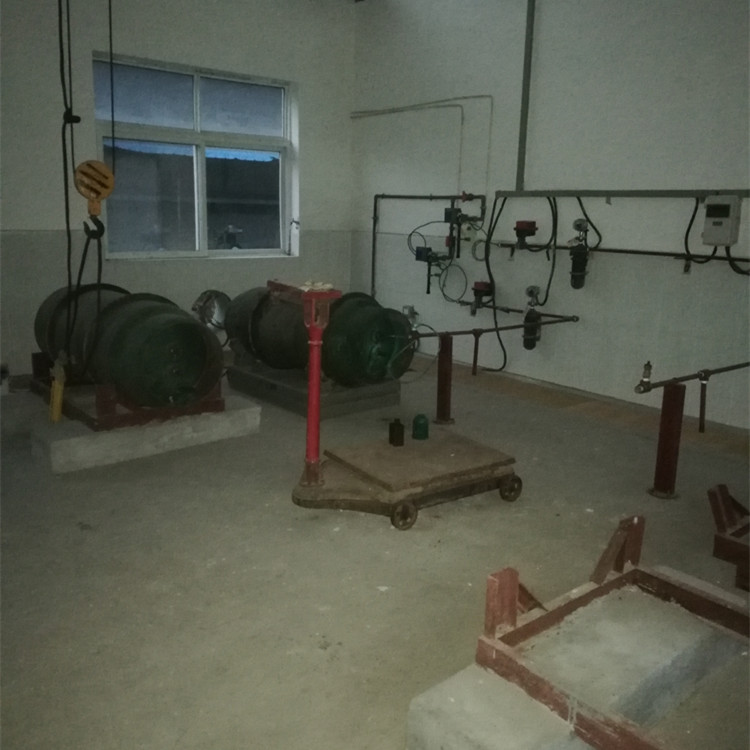
 概述
In processes for removing ruthenium by distilling RuO4from ruthenate-containing solutions with these steps of
the treatment of the ruthenate-containing solution with an oxidising agent,
distilling off of the RuOformed,
absorbing the RuOfrom step II in hydrochloric acid,
the oxidising agent is recycled into step I following step II. The processes can be carried out in reactor modules with
A a reactor with a stirrer,gas inlet and gas outlet,
B at least one scrubber connected in series downstream with the gas outlet via a line,
C one or several gas absorbers connected in series down- stream with the at least one scrubber via lines,
E at least one line from the optionally last absorber for recycling into the gas inlet of the reactor
or into a further module
or into a facility for off-gas treatment.
通過(guò)以下步驟從含釕酸鹽的溶液中蒸餾RuO4來(lái)去除釕的方法中:
用氧化劑處理含釕酸鹽的溶液,蒸餾RuO形成,吸收RuO從步驟II的鹽酸中,氧化劑在步驟II之后再循環(huán)到步驟I中。該過(guò)程可以在具有一種具有攪拌器、氣體入口和氣體出口的反應(yīng)器,B至少一個(gè)洗滌器,所述洗滌器經(jīng)由管線在所述氣體出口的下游串聯(lián)連接,C一個(gè)或多個(gè)氣體吸收器,其通過(guò)管線與至少一個(gè)洗滌器串聯(lián)在下游,E來(lái)自任選*后一個(gè)吸收器的至少一條管線,用于再循環(huán)到反應(yīng)器的氣體入口中或進(jìn)入另一個(gè)模塊或者進(jìn)入用于廢氣處理的設(shè)施。
[0001] The invention relates to processes and devices for removing ruthenium as RuO4 from ruthenate-containing solutions by distillation.
本發(fā)明涉及通過(guò)蒸餾從含釕酸鹽的溶液中以RuO4形式除去釕的方法和裝置。
[0002] Parting products containing ruthenium(and,if applicable,osmium)are treated initially with an alkaline oxi- dising melt,forexample,
概述
In processes for removing ruthenium by distilling RuO4from ruthenate-containing solutions with these steps of
the treatment of the ruthenate-containing solution with an oxidising agent,
distilling off of the RuOformed,
absorbing the RuOfrom step II in hydrochloric acid,
the oxidising agent is recycled into step I following step II. The processes can be carried out in reactor modules with
A a reactor with a stirrer,gas inlet and gas outlet,
B at least one scrubber connected in series downstream with the gas outlet via a line,
C one or several gas absorbers connected in series down- stream with the at least one scrubber via lines,
E at least one line from the optionally last absorber for recycling into the gas inlet of the reactor
or into a further module
or into a facility for off-gas treatment.
通過(guò)以下步驟從含釕酸鹽的溶液中蒸餾RuO4來(lái)去除釕的方法中:
用氧化劑處理含釕酸鹽的溶液,蒸餾RuO形成,吸收RuO從步驟II的鹽酸中,氧化劑在步驟II之后再循環(huán)到步驟I中。該過(guò)程可以在具有一種具有攪拌器、氣體入口和氣體出口的反應(yīng)器,B至少一個(gè)洗滌器,所述洗滌器經(jīng)由管線在所述氣體出口的下游串聯(lián)連接,C一個(gè)或多個(gè)氣體吸收器,其通過(guò)管線與至少一個(gè)洗滌器串聯(lián)在下游,E來(lái)自任選*后一個(gè)吸收器的至少一條管線,用于再循環(huán)到反應(yīng)器的氣體入口中或進(jìn)入另一個(gè)模塊或者進(jìn)入用于廢氣處理的設(shè)施。
[0001] The invention relates to processes and devices for removing ruthenium as RuO4 from ruthenate-containing solutions by distillation.
本發(fā)明涉及通過(guò)蒸餾從含釕酸鹽的溶液中以RuO4形式除去釕的方法和裝置。
[0002] Parting products containing ruthenium(and,if applicable,osmium)are treated initially with an alkaline oxi- dising melt,forexample,to recover the noble metals.Follow- ing leaching,solutions are obtained therefrom which contain K
RuO(and,if applicable,KOsO).The elements Ru and Os are advantageously partitioned oxidatively as tetroxides. Suitable oxidising agents for this purpose are e.g.oxygen/ ozone,H
O/sulphuric acid,peroxodisulphate,bromine or chlorine.The tetroxides are separated off by distillation.
例如,含有釕(以及鋨,如果適用)的分離產(chǎn)物*初用堿性氧氣熔體處理,以回收貴金屬。在浸出之后,從中獲得含有K的溶液RuO(如果適用,KOsO).元素Ru和Os有利地被氧化分配為四氧化二磷。適用于此目的的氧化劑有:氧氣/臭氧、HO/硫酸、過(guò)氧二硫酸鹽、溴或氯。四氧化二磷通過(guò)蒸餾分離出來(lái)
[0003] From JP61006130A,it is known to saturate ruthen- ate-containing aqueous solutions from alkaline melt leaching with chlorine gas,to decompose the hypochlorite formed by acidification,to distill off RuO
and to take it up in HCl.A yield of 99%is indicated as being obtained on a laboratory scale.
從JP61006130A中,已知用氯氣飽和來(lái)自堿性熔融浸出的含釕酸鹽的水溶液,以分解通過(guò)酸化形成的次氯酸鹽,從而蒸餾出RuO并將其吸收在HCl中。99%的產(chǎn)率表明是在實(shí)驗(yàn)室規(guī)模上獲得的。
[0004] To liberate RuO,chlorine is consumed: 解放魯,氯被消耗:
2K+RuO-+Cl→RuO+2KCl (I)
[0005] During absorption in HCl,twice the quantity of chlorine is liberated:
在吸收HCl的過(guò)程中,釋放出兩倍量的氯:
RuO+10HCl→HRuCl+2Cl+4HO (I)
[0006] When an oxidising agent such as chlorine or a chlo- rine/air mixture is passed through the ruthenate-containing solution on an industrial scale and acts as entrainer for RuO
, a large quantity of oxidising agent is consumed in the process.
當(dāng)氧化劑(如氯或氯/空氣混合物)在工業(yè)規(guī)模上通過(guò)含釕酸鹽的溶液并作為釕的夾帶劑時(shí), 在該過(guò)程中消耗了大量的氧化劑。
[0007] The invention attempts above all to remedy this problem.It has the object of providing a process forremoving ruthenium as RuO
from ruthenate-containing solutions by distillation,in which process the oxidising agent is used as efficiently as possible with a high yield.
本發(fā)明首先試圖解決這個(gè)問(wèn)題。其目的是提供一種以RuO形式去除釕的方法通過(guò)蒸餾從含有釕酸鹽的溶液中提取,在該過(guò)程中,氧化劑以盡可能高的產(chǎn)率被有效地使用。
[0008] A furtherobject is the provisionofa process suitable for automation. 另一個(gè)目標(biāo)是提供一個(gè)適合自動(dòng)化的過(guò)程。
[0009] The object is achieved by way of processes accord- ing to claim 1.Advantageous embodiments can be found in the further claims.
該目的是通過(guò)根據(jù)權(quán)利要求1的方法實(shí)現(xiàn)的。在進(jìn)一步的權(quán)利要求中可以找到有利的實(shí)施方案。
[0010 ] In this process,the oxidising agent,e.g.a chlorine/ air mixture,is recycled within a distillation facility.
在這個(gè)過(guò)程中,氧化劑,例如氯/空氣混合物,在蒸餾設(shè)備中循環(huán)使用
[0011] Advantageously,the reactor is heatable and cool- able such that the temperature development can be controlled in an automated manner.
有利的是,反應(yīng)器是可加熱和可冷卻的,從而可以以自動(dòng)方式控制溫度發(fā)展。
[0012] It is advantageous to connect several distillation facilities in series as modules.Appropriately,the process is controlled in such a way that as soon as excess oxidising agent,e.g.chlorine,is developed in a facility,its gas mixture is pumped into the next facility.In this way,ifchlorine is used as oxidising agent,chlorine produced in the process,too,is utilised for the oxidation of ruthenate.With this method of operation,approximately 1.9 kg of chlorine per kg of Ru,for example,are introduced from outside.As a result of the recycling operation,approximately 0.2 kg of chlorine per kg of Ru pass into the off-gas purification facility.
將幾個(gè)蒸餾設(shè)施串聯(lián)作為模塊是有利的。適當(dāng)?shù)兀刂圃撨^(guò)程的方式是,一旦在一個(gè)設(shè)施中產(chǎn)生過(guò)量的氧化劑,如氯,其氣體混合物就會(huì)被泵送到下一個(gè)設(shè)施。通過(guò)這種方式,如果氯被用作氧化劑,那么在該過(guò)程中產(chǎn)生的氯也被用于釕酸鹽的氧化。利用這種操作方法,例如,從外部引入每千克Ru大約1.9千克氯。作為再循環(huán)操作的結(jié)果,每公斤Ru大約有0.2公斤氯進(jìn)入廢氣凈化設(shè)施。
[0013] If the pH of the alkaline ruthenate-containing solu- tion is reduced with acid before introducing the chlorine,the violence of the reaction is easier to control.
如果在引入氯之前用酸降低含釕酸鹽的堿性溶液的pH,則反應(yīng)的劇烈程度更容易控制。
[0014] It has proved to be advantageous to keep the con- centration of hydrochloric acid in which RuOis taken up at ahigh level,appropriately above 5 mole/1,by introducing HCl gas to prevent RuO
from accumulating.
事實(shí)證明,保持RuO中鹽酸的濃度是有利的通過(guò)引入HCl氣體以防止RuO,在較高水平(適當(dāng)?shù)馗哂?/span>5摩爾/1)下被吸收防止積累。
[0015] Appropriately,the process is integrated into a pro- cedure for recovering ruthenium from partitioning products. In this case,the absorbed H
RuCls and the mother liquors which have arisen are worked up in a manner known to the expert
適當(dāng)?shù)兀瑢⒃撨^(guò)程整合到從分配產(chǎn)物中回收釕的過(guò)程中。在這種情況下,吸收的HRuCl和出現(xiàn)的母液是以專家已知的方式處理的
[0016] The process according to the invention is elucidated by way ofthe following example.Parts and percentages relate to the weight,as they do in the rest of the description,unless indicated otherwise.
根據(jù)本發(fā)明的方法通過(guò)以下實(shí)施例來(lái)闡明。除非另有說(shuō)明,否則部分和百分比與重量有關(guān),與說(shuō)明書其余部分相同。
EXAMPLE 例子
[0017] Aruthenium-containing melt cake from the alkaline oxidising melt is leached with non-potable water with stir- ring.The potassium/sodium ruthenate solution obtained is introduced into a glass flask and subsequently pumped into a
receiving vessel.
用非飲用水通過(guò)攪拌環(huán)對(duì)堿性氧化熔體中的含砷熔體濾餅進(jìn)行浸出。將獲得的釕酸鉀/鈉溶液引入玻璃燒瓶中,隨后泵入接收船。
[0018] A5001reactor with a gas inlet,stirrer,gas outlet and a 501 washing flask connected to it,which flask is connected to four absorber receiving vessels connected in series and filled with concentrated HCl (first receiving vessel),diluted HCl(2nd and 3rd receiving vessel)and water(4th receiving vessel)is supplied with 50-801 of the potassium/sodium ruthenate solution and filled with service water to a level of
3001.Depending on the predetermined concentration of potassium/sodium ruthenate solution,5-101 of concentrated technical grade HNO
are added to the solution and the tem- perature is raised to 50°C.
A5001反應(yīng)器,具有氣體入口、攪拌器、氣體出口和與其相連的501洗滌燒瓶,該燒瓶連接到四個(gè)串聯(lián)連接并填充有濃HCl的吸收塔接收容器(一級(jí)接收容器),向稀釋的HCl(第二和第三接收容器)和水(第四接收容器)供應(yīng)50-801的釕酸鉀/鈉溶液,并用廠用水填充至3001.根據(jù)釕酸鉀/鈉溶液的預(yù)定濃度,5-101的濃縮工業(yè)級(jí)HNO加入溶液中,溫度升至50°C。
[0019] 2.5m³/hofchlorine are introduced into the solution via an inlet pipe.On termination of the temperature hike,
heating is carried out.
2.5立方米/小時(shí)的氯通過(guò)入口管引入溶液中。在溫度升高終止時(shí),進(jìn)行加熱。
[0020] All the liquid ruthenium tetroxide that has collected at the bottom of the distillation flask is distilled off and col- lected in the receiving vessels.
在蒸餾燒瓶底部收集的所有液態(tài)四氧化釕都被蒸餾掉,并在接收容器中收集。
[0021] Before the end of the RuOdistillation,HCl gas is introduced into the first receiving vessel.RuO4 reacts to form HRuCls according to equation(II)in this process.The intro- duction is started once a temperature 80-85°C.has been reached in the distillation flask.
在RuO結(jié)束之前將HCl氣體引入一級(jí)接收容器中。RuO4反應(yīng)生成H在該過(guò)程中根據(jù)方程(II)的RuCls。一旦蒸餾燒瓶中的溫度達(dá)到80-85°C,就開(kāi)始引入。
[0022] The reaction is terminated when the washing water in the washing flask becomes almost colourless,a tempera- ture of at least 98°C.has been reached in the reactor and no further RuOis visible at the bottom of the washing flask.
當(dāng)洗滌燒瓶中的洗滌水幾乎無(wú)色,反應(yīng)器中的溫度至少達(dá)到98°C,且沒(méi)有進(jìn)一步的RuO時(shí),反應(yīng)終止在洗滌燒瓶的底部可見(jiàn)。
[0023] The stream of chlorine is interrupted.
氯氣流中斷。
[0024] The stream of HCl into the receiving vessels is maintained for a further 1-2 h.
將進(jìn)入接收容器的HCl流再維持1-2小時(shí)。
[0025] The residue in the reactor is treated with 3-41 of 45-50%technical grade NaOH.
反應(yīng)器中的殘留物用3-41的45-50%的工業(yè)級(jí)NaOH處理。
[0026] The HRuCl/RuClsolution obtained is removed from the absorber receiving vessels.
H氯化釕/氯化釕將獲得的溶液從吸收器接收容器中移除。
[0027] The invention also relates to devices according to
claim 9 for carrying out the process described.
本發(fā)明還涉及根據(jù)權(quán)利要求9所述的方法。
[0028] FIG.1 shows a module of an exemplary device for
executing the process.
圖1示出了用于執(zhí)行該過(guò)程。
[0029] In the case of the module,a washing fask 2 is connected in series downstream to a reactor 1 with a stirrer 4, gas inlet 5 and gas outlet 6,in which washing flask the g




 蘇公網(wǎng)安備32050702012747號(hào)